
Am I Doing EMDR Right? From EMDR Basic Training and Beyond.
Updated: Aug 29
A Systemic Consent Perspective on Confidence, Flexibility, and Attuned Practice
by Sam Bergstein, LISW-S (OH), LCSW (CA), REAT, | EMDRIA-Approved Consultant | The Guided Studio
If you have ever sat across from a client mid-session and quietly wondered, “am I doing this right?” you are in good company. That question surfaces for nearly every EMDR therapist at some point, and it tends to arrive most loudly in the moments that matter most: when a client dissociates, when a protective part steps in and slows everything down, when processing feels quiet and ambiguous rather than vivid and dramatic, and when the typical resourcing go-to we learn in basic training seems to not land for a specific client.
The question itself is not a sign of incompetence. In many ways, it is a sign of clinical conscience. The problem is what we do with it. When that question triggers a spiral of self-monitoring and performance pressure, it can pull us away from the very thing that makes EMDR work: genuine, attuned presence with the person in front of us.
Framework
As I’ve refined my practice through training and experience and have regularly worked with other clinicians in EMDR training and consultation, I’ve thoroughly defined my approach and stance on some aspects of practice. Through my hyperfixations of learning more and creating resources for other clinicians, I realized that I’ve got a set of principles that I practice by. I may be biased, but I think they’re pretty important. I greatly attribute much of what has brought me to my philosophy (philosophies?) to the teachings of Institute for Creative Mindfulness, including founder Dr. Jamie Marich, faculty Amy Wagner and Dr. Rachel Weaver, and the amazing trainers/ICM faculty I’ve been lucky to support as a training assistant: Suzi Rutti, Roshni Chabra, Irene Rodriguez, and Dr. Stephen Dansinger along with some other amazing colleagues at the Institute for Creative Mindfulness.
Ultimately, I’ve come to call my set of philosophies that I live and work by the Systemic Consent EMDR Framework™. [I also want to note, there’s a part of me that feels icky adding a trademark symbol here but hey, the framework deserves it]. The framework is a relational and philosophical operating system that runs alongside the standard 8-phase model, designed to help therapists move from rigid protocol-following toward flexible, deeply collaborative, and ethically grounded practice.

This post explores what it I believe actually means to “do EMDR well”, through the lens of the Systemic Consent EMDR Framework™
The Question Behind the Question
When therapists ask "am I doing EMDR right?", they are rarely asking about the mechanics. They already know the phases. What they are really asking is something closer to: Is what I'm doing safe? Is it helping? Am I missing something important? Is my client’s EMDR experience “normal?”
These are the right questions. They reflect the kind of clinical attunement that the Systemic Consent EMDR Framework™ places at the center of everything. The framework's fifth pillar, the Therapist as Part of the System, holds that the therapist's own regulation, internal responses, and nervous system are not background noise. They are active ingredients in the therapeutic process. When a therapist's anxiety about "doing it right" begins to drive clinical decisions, that is not a personal failure. It is a parts-informed signal worth paying attention to.
The goal is not to silence that anxious part. The goal is to understand what it needs so it does not run the session. The goal is to help oneself identify: is this anxiety about something else or is it about actual signals I’m getting from this client.
What EMDR Actually Requires: Decoding What We Learn in EMDR Training
One of the most liberating reframes in the Systemic Consent EMDR Framework™ is the distinction between what is non-negotiable in EMDR and what is genuinely flexible. Many therapists carry an implicit belief that flexibility equals doing it wrong or doing something that isn’t actually real EMDR. In practice, the opposite is often true: thoughtful, attuned flexibility is a hallmark of skilled clinical judgment.
The non-negotiables are fewer than most new therapists expect, and they are relational rather than procedural in nature. They include maintaining safety and stabilization, practicing genuine consent and collaboration, attending to memory networks in whatever form they arise, supporting dual awareness, and staying attuned to the specific client in front of you. Not an idealized version of what a client "should" look like in EMDR.

The Continuous Consent pillar of the framework is particularly relevant here. Consent in EMDR is not a signature on an intake form. It is a living, moment-to-moment dialogue. It means checking in before initiating bilateral stimulation, noticing when a client's system has shifted, and being willing to adjust course when the nervous system signals that it needs something different.
This kind of consent cannot be scripted. It has to be felt and given a voice (not necessarily a verbal voice…) when more information is needed.
And when I say: “This kind of consent cannot be scripted,” I don’t mean that there aren’t tools that can help you better understand your client’s consent. Actually, tools can be VERY helpful here. Here's an example of a non-directive tool you can use:

Note: This page is pulled directly from the EMDR + Parts Work Session Support Menu Toolkit. If you want more visual tools for your sessions, you can find the full toolkit in the shop.
What Each Phase Is Actually For
A common source of performance anxiety in EMDR is the belief that each phase must look a certain way and move at a certain pace. The table below offers a reframe: rather than thinking about phases as steps to complete, consider what each phase is for and what your role within it actually is.
Phase | Core Purpose | Therapist's Primary Role |
1. History & Context | Understand patterns, resources, pacing needs | Listen, track, assess readiness, build therapeutic alliance with client, assess consent and work with concerns. |
2. Preparation & Stabilization | Build safety, consent, and regulation capacity | Teach, reinforce resources, normalize, assess consent and work with concerns. |
3. Target Assessment | Clarify target, assess tolerance and consent | Guide focus, check in, assess consent and work with concerns. |
4. Processing | Support adaptive information processing | Track affect and dissociation, adjust pacing, allow space for shifts in consent (honor autonomy and self-determination). |
5. Installation | Strengthen adaptive beliefs | Reinforce congruence, allow space for shifts in consent and (honor autonomy and self-determination). |
6. Body Scan | Clear residual body activation | Invite gentle body awareness, allow space for shifts in consent (honor autonomy and self-determination) |
7. Closure | Ground and orient to the present | Re-orient, reinforce resources, contain, plan for aftercare and safety if needed, allow space for shifts in consent (honor autonomy and self-determination) |
8. Reevaluation | Assess how the work is holding over time | Review changes, adjust plan, allow space for shifts in consent (honor autonomy and self-determination) |
What this table makes visible is that the therapist's role across all eight phases is fundamentally relational and responsive. There is no phase where the job is simply to execute a procedure. Every phase asks you to be present, to track, to adjust, and to collaborate which is precisely what the Systemic View pillar of the framework describes: treating the client as a whole, resourceful internal system, not a collection of symptoms to be processed in sequence.
Flexibility Is Not a Loophole
The areas of EMDR that are appropriately flexible are broader than most training programs communicate. Target selection does not require a single, clearly defined memory. Themes, fragments, and symbolic representations are all valid entry points depending on the specific client’s needs. Language does not need to follow EMDR-specific phrasing if those phrases do not land for a particular client. Pacing is not a measure of quality; slower processing is not inferior processing [note: Slower doesn’t necessarily mean slower bilateral (though ideal client activation speed can vary) slower pacing here refers to the speed at which we enter and complete a target]. Resourcing does not require visualization; sensory, movement-based, and expressive approaches are clinically sound alternatives.
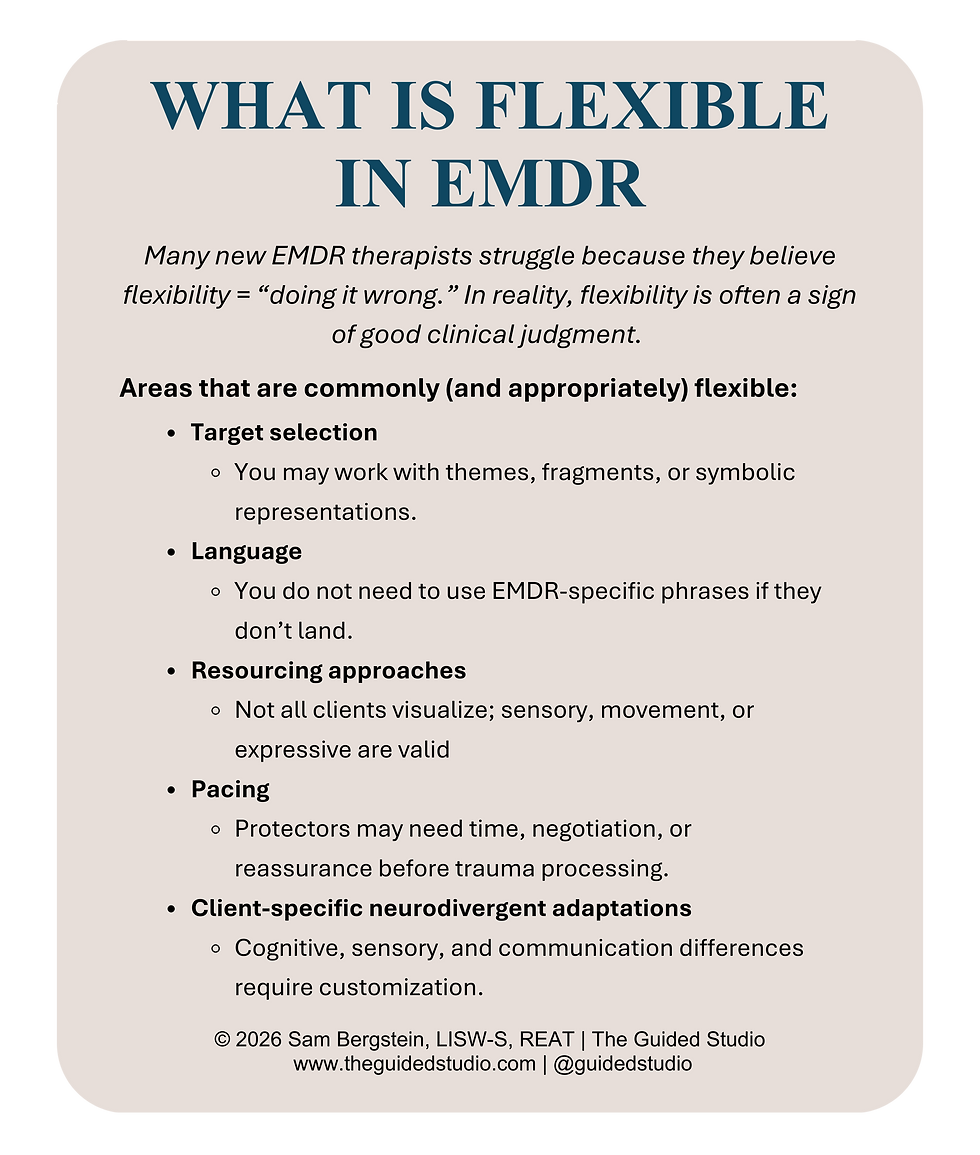
The Neurodivergent-Affirming by Design pillar of the Systemic Consent EMDR Framework™ makes this explicit. The framework adapts to the client, not the other way around. For neurodivergent clients (including autistic clients, clients with ADHD, clients with sensory processing differences, and more) standard EMDR language and imagery-based approaches may not be the most effective or most affirming access points. Verbal processing, movement, processing with little-to-no verbalization or affect (or, on the other end, lots of affect), processing with more need for structure and logic can all be valid routes of engaging in the process effectively depending on the person. Recognizing the variance and need for adaptation is not a departure from good EMDR practice. It is good EMDR practice.
Similarly, the Parts-Informed at Every Phase pillar reframes one of the most common sources of therapist confusion: protective responses. When a client slows down, avoids, intellectualizes, or seems reluctant to continue, this is not resistance. It is information. Protectors exist because they have kept the system safe. They deserve acknowledgment, negotiation, and respect. Not override.
Signs You Are Doing Enough, Even When It Feels Messy
The sessions that feel most uncertain are often the ones where the most important clinical work is happening. Here are the indicators that matter not whether the session looked like a training video, but whether the conditions for safe, collaborative processing were present.
You are doing enough when the client remains engaged and oriented, when protective responses are acknowledged rather than overridden, when the client returns to subsequent sessions regulated enough to continue, when the system can tolerate contact with difficult material without flooding, and when you are tracking safety rather than chasing intensity.
EMDR does not need to look dramatic to be effective. Quiet can still be processing. Pausing is an intervention. Slowing down is not stalling, it is attunement in action.
When to Slow, Pause, or Stop
One of the most practical clinical skills in EMDR is knowing how to read the nervous system's signals and respond accordingly.

Note: This page is pulled directly from the resource: Consent, Pacing & Visual Tools for EMDR. If you want more visual tools for your sessions, you can find the full toolkit in the shop.
The Role of Consultation and Ongoing Learning
One of the most persistent myths in EMDR practice is the belief that a trained therapist should be able to navigate all of this independently. In reality, EMDR was never designed to be practiced in isolation. Consultation is not remediation. It is where EMDR becomes contextual, nuanced, and sustainable.
In consultation, therapists make sense of complex client responses, normalize slow or non-linear processing, learn to adapt for dissociation and neurodivergence, and receive support when self-doubt arises. Many experienced EMDR clinicians continue consultation long after certification not because they lack confidence, but because they understand that EMDR changes depending on who you are working with and who you are as a therapist in that moment.
Basic training provides the map. Consultation helps you navigate the terrain.
There are also moments when consultation alone is not sufficient, when the complexity of the work genuinely calls for advanced or specialized training. This is not a judgment about competence. It is a scope-aware recognition that certain presentations, such as complex developmental trauma, neurodivergent systems, early relational trauma, OCD (and more) may require a deeper skill set than foundational training provides. Seeking that training is an investment in ethical, sustainable practice.
“AM I DOING EMDR RIGHT?” DESK REFERENCE: 1 PAGE CHECK-IN
I love being able to cross my t's and dot my i's, especially when I'm having a complex session. I made a desk reference to help myself in those moments.
This free printable walks you through four fast check-ins:
Safety First: Is the client oriented and able to leave safely?
Process over Performance: Are you prioritizing attunement over protocol?
Therapist Regulation: Are you grounded enough to continue?
Support Needs: Is this a pause moment, a consultation moment, or a referral moment?

Print it out. Keep it close. Laminate it. Bring it to consultation or supervision. (Maybe make notes of what to address in your own therapy as shown above). They sky is the limit. And the next time you wonder if you are doing it right, let this page remind you that being human, being attuned, and being willing to slow down is the work.

A Final Anchor
The Systemic Consent EMDR Framework™ offers a simple but powerful reframe for the question that opened this post. "Am I doing EMDR right?" is not a question about protocol adherence. It is a question about whether you are present, attuned, and collaborative. Whether you are honoring the wholeness of the client's internal system, practicing consent as a living process, and bringing your own regulated nervous system (or regulated enough. It’s ok to not be perfect) into the room as a resource.
If you are prioritizing safety over intensity, pacing over pushing, attunement over rigidity, and treating protective responses as information rather than obstacles, you are doing EMDR. Even when it feels messy. Even when it is slow. Even when it does not look like anyone else's sessions.


Comments