_edited_edited.jpg)
We all need to play and create: Lessons from my time at the EMDRIA 2026 Conference in Anaheim
My goal for The Guided Studio's exhibitor booth at the EMDRIA 2026 conference this year was to bring playful creativity into the space. I've attended many times but 2026 was my first experience exhibiting for myself. I love seeing how fun and interesting and creative others get with their booths at the conference, and I was inspired.

As always, I had a lot of ideas and (definitely) too many hopes and plans to pull off in time for one conference. So, believe it or not, these are the pared down features and offerings I highlighted at my booth:
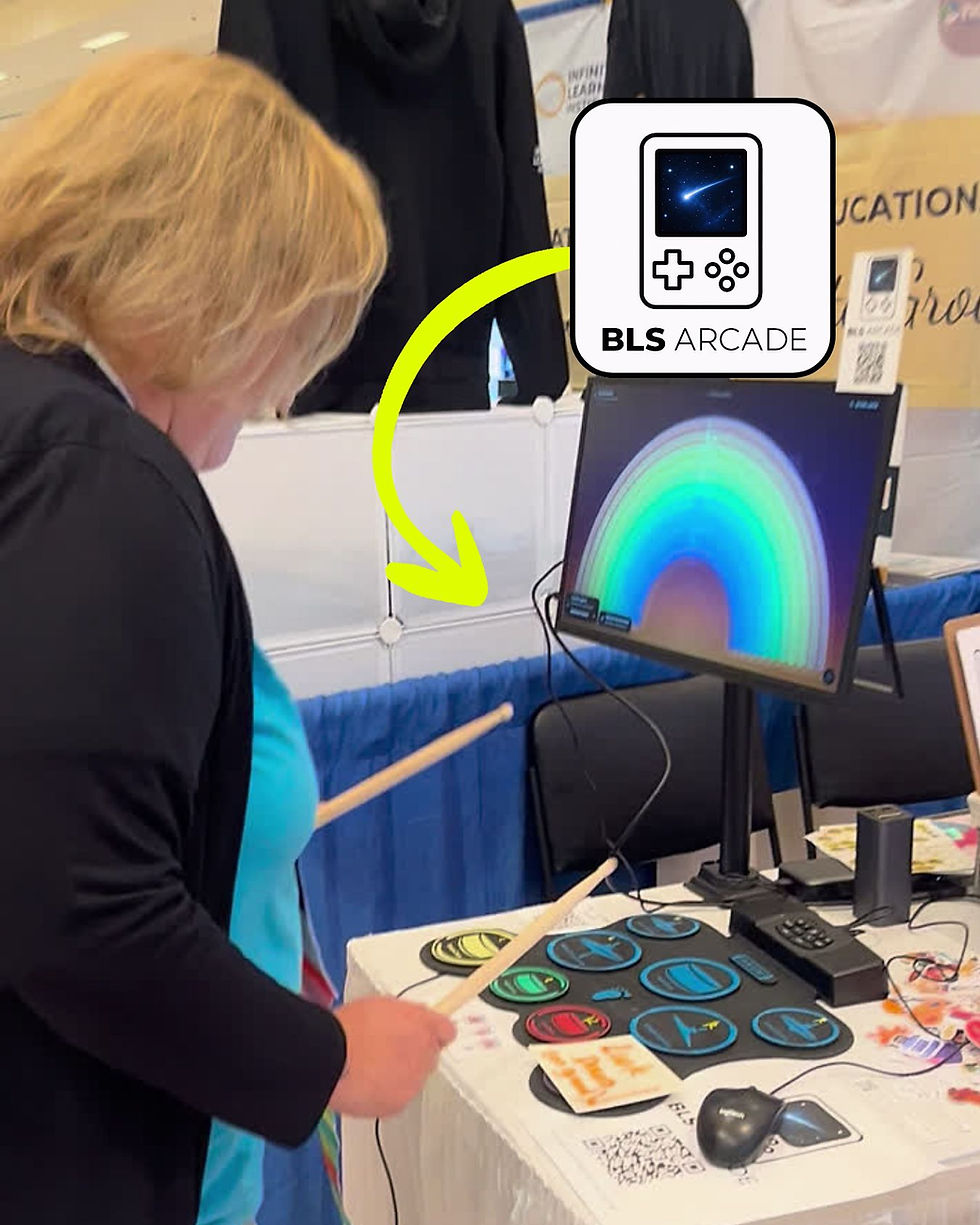
BLS Arcade: A suite of playful, creative, and engaging bilateral stimulation tools for EMDR therapists to use in remote and in-office sessions
BLS Arcade is absolutely my current biggest baby. It's weaning off the bottle, but just barely. I've been refining it for months for the conference but there's always more I could do.

I soft launched BLS Arcade in my close networks and mailing list and on some Facebook groups but EMDRIA was the test to answer the question: Will other therapists like what I've been building?
And did they like it? Did they smile and squee as they played the MIDI drum set bilaterally, simultaneously painting a rainbow across the sky or feeding pandas bamboo just as I hoped?

Yes, yes they did.
[tired part who has been working so hard on this lets out a big sigh of relief]

BLS Arcade and The Guided Studio platform are set to become a full ecosystem of tools: BLS Arcade, Parts Studio, Creative Suite, and Resource Vault (more coming on the last 3 soon). I'm also working on some sweeeeet VR features for the platform but, surprise surprise, building VR tools is not an easy task. I'd estimate the BLS Arcade VR features will likely start to unveil in early 2027.
EMDRIA 2026 Community Art Wall and Art Trading Cards
I hoped but I didn't KNOW this would be so powerful. Participants were invited to create art, leave it on the wall, trade it, or take it with them.
Not only does the community aspect create a powerful feeling of connection and collective expression but participants used many of the different available supplies and tools to meet their needs, comfort level, and express on different levels.
And the coolest part was watching it change over the course of the conference. It started as a mostly empty grid with a few things I'd put up to make the invitation feel less intimidating. Then people started adding things. And trading things. And stopping to look at what other therapists had made.

By the end, it had become something I couldn't have designed ahead of time because the whole point was that I wasn't the one designing it anymore.
Everyone got to decide what they made, what materials they used, whether they followed a prompt at all, whether they kept it, whether they shared it, and whether something they had shared stayed on the wall.
Which, now that I think about it, is a pretty good physical representation of a lot of what I'm trying to build clinically, too.
We also offered: a cozy corner to create in (which was mostly used by ME but a few comfy friends came in as well); 90 second art prompts- many engaged in art/creativity for longer but the prompts gave a quick and low pressure way in; and an EMDRIA 2026 community doodle board- Added late on the second day, it didn't get fully filled up but gave a little doodley alternative to creating something more substantial while still feeling the community creativity vibe.
Freebies:
In true expressive arts therapist form, I made my own booth goodies.

The mini expressive arts kits included some fun and playful stuff. Nothing really fancy. I wanted to include a few different items for multimodal work as well as some things to bring sensory and inner child connection in.


I discussed this Free Phase 2 Expressive Arts Sensory Card Deck: A free 12 card deck for therapists to use for creative, sensory rich resource building quite a lot at the conference.

Another big part of what I brought to EMDRIA was the Systemic Consent EMDR Framework. My complete toolkit for integrating Parts Work* into EMDR in a way that honors diverse experiences and minds.
If the playful side of my booth was about creating more ways into the work, Systemic Consent is, in a lot of ways, about creating more ways to stay collaborative once we're there. And how play, creativity, and consent can interconnectedly support each other.

The framework grew out of something I kept noticing in my own EMDR work: consent isn't just the yes or no that happens before we start reprocessing. It's something we can continue attending to throughout the work.
That includes how we introduce EMDR, how we talk about what is happening, how we respond when something shifts, how we pace, and how we make room for hesitation, uncertainty, protective responses, changing needs, and all the other information that can show up along the way.
It also means looking beyond any single therapist-client interaction and considering the larger systems around EMDR: the language we use, expectations about what therapy is "supposed" to look like, clinical tools and procedures, training, consultation, and the structures clinicians are working within.
A lot of the resources I've created over the past few years have grown from that same philosophy, so the Systemic Consent EMDR Framework™ Signature Collection brings those tools together into a larger clinical resource collection.

And one of the things I was especially excited to share at EMDRIA was making the framework available beyond individual clinicians. I now have Consultant & Trainer licensing for consultants, trainers, group practices, and organizations who want to use the collection with more of the clinicians they support.
*I sometimes get asked 'Sam, why do you say "parts work" instead of "IFS" when you talk about parts?' Read more about that here:
Consultation and future training
One of my favorite parts of exhibiting was getting to actually TALK to and ENGAGE with so many of you. (I wanted to add "engage" in there because sometimes we didn't just talk! Sometimes we played, created, etc.)
I offer EMDR consultation for clinicians working toward certification, for EMDRIA certified clinicians hoping to become consultants themselves (consultants in training / CITs) as well as clinicians who just want somewhere to bring the complicated, confusing, "okay but what do I actually do with this?" parts of the work.
My consultation tends to reflect the same things you saw all over my booth: lots of attention to collaboration and consent, plus parts work, expressive arts, neurodivergence, complex trauma, dissociation, and creative ways of adapting EMDR when the neat version from the training manual isn't quite matching the human sitting in front of us.
I currently offer individual consultation as well as small consultation groups, including my longer EMDR, Parts Work + Expressive Arts consultation groups.

Go to Sam/The Guided Studio's sister company, Mantra Mental Health, LLC, at the link above to see more about consultation and schedule
And yes: expressive arts therapy and advanced topics EMDRIA trainings are coming.

Sterling and I are both clinical social workers, EMDRIA-approved consultants and Registered Expressive Arts Therapists, and we’re building Prism as a clinical training home for therapists who want to bring expressive arts into their work in ways that are thoughtful, trauma-competent, neurodivergent-affirming, and grounded in consent.
Prism is being developed for clinicians who want more than a few art directives to pull out when words stop working. The emphasis is on understanding how to facilitate expressive arts as a clinical process: how to work with visual art, movement, sound, symbol, sensory experience, and other creative modalities while staying attentive to pacing, nervous system regulation, scope of practice, and the client’s own meaning-making.
A few of the areas we’re building our expressive arts therapy training around include:
expressive arts for EMDR preparation and resourcing
expressive arts and parts work
working with complex trauma and dissociation
neurodivergent-affirming expressive arts practice
individual and group expressive arts facilitation
collective regulation through rhythm, sound, and movement
phenomenological inquiry and learning to witness artwork without interpreting it for the client
consent, ethics, pacing, and accessibility in expressive arts work
Ultimately, we are building a comprehensive Expressive Arts Therapy Certificate Program for licensed clinicians, alongside stand-alone workshops and electives for people who want to learn specific areas without committing to a full certificate pathway.

A big part of the Prism framework is the idea that creative work does not need to be polished, impressive, or even especially "artistic" to be clinically meaningful. Directives are invitations, not instructions. Clients get to choose how, whether, and how deeply they engage. We’re interested in helping therapists build enough confidence and clinical grounding to use creativity without turning the artwork into something to analyze, decode, or perform correctly.
That overlaps a lot with what you saw at my EMDRIA booth, which is probably why talking with so many therapists there made me even more excited to keep moving these trainings forward.
There is more coming from The Guided Studio, too.
BLS Arcade is live now, and I'm continuing to build out the larger Guided Studio ecosystem. Parts Studio, Creative Suite, and Resource Vault are all part of that bigger vision, although I'm intentionally taking my time with them rather than releasing things just because I can.
I'm also working on VR tools for the platform. Those are very much still in development because, it turns out, casually deciding to build therapeutic VR experiences is not a small side quest. 😂 My current hope is that you'll start seeing some of those BLS Arcade VR features in early 2027.
And apparently I've become an inventor, too.
One of the stranger sentences I get to write after this year is:
some of this work is now patent pending.
Over the past year, I've realized that some of the things I was building weren't just new resources or new ways of packaging existing clinical tools. I was starting to design entirely new systems for how therapists and clients can interact with technology during therapy.
So I've begun protecting some of that work while I continue developing it.
I'm intentionally not sharing every technical detail yet, but the bigger ideas include things like making bilateral stimulation more interactive and responsive; creating new ways for physical controls, movement, sound, visual environments, and immersive experiences to interact with therapeutic software; designing technology that can respond to what is happening in a session without taking clinical decision-making away from the therapist; and building safety, consent, pacing, and privacy into the architecture itself rather than treating them as disclaimers added afterward.
That last part is especially important to me.
A lot of mental health technology starts with the question, "What can the technology do?"
I'm much more interested in questions like:
What should the technology be allowed to do?
What should always stay under the therapist's or client's control?
How can consent remain changeable in the middle of an experience?
How do we make something responsive without quietly turning it into an autonomous clinical decision-maker?
How can technology support complex, nonlinear humans instead of requiring humans to behave predictably for the technology?
And, because apparently I cannot leave well enough alone:
What happens when bilateral stimulation becomes something you can actually interact with?
That last question is part of what you've already started seeing in BLS Arcade. At EMDRIA, therapists weren't just watching a dot move across a screen. They were playing with bilateral experiences using visual environments and physical controls. I'm continuing to experiment with ways that keyboards, game controllers, MIDI devices, custom physical interfaces, sound, movement, and eventually immersive environments can become different ways of interacting with these experiences.
Some of these ideas now have patent-pending protection through provisional patent applications while I continue building, testing, refining, and figuring out which ones deserve to become real products.
And that distinction matters to me: I don't want to invent complicated technology simply because I can.
I want to build things that let us do something meaningfully different.
Sometimes that means sophisticated technology. Sometimes it means handing someone two drumsticks and watching their face light up when they realize they can play the rainbow on the screen.
Some takeaways
I had so many good conversations and interactions with so many amazing therapists. Y'all are doing amazing things out there and I'm so grateful to be a part of this amazing community of passionate people.
If you know me, you likely know I'm into parts work and expressive arts in my EMDR work and bring a lot of creativity and play into my work. So, naturally, my booth was an explosion of rainbows, art supplies, and playful touches. And y'all responded to it!
Here are some of my takeaways from my experience:
A surprising one: some clinicians and adults don't see creativity and play as for them
I can't tell you how many people walked by and when invited into the booth they said "this looks so cool, but I don't work with kids!"
And actually, though I've worked with kids in the past, I mostly exclusively work with adults right now. And have designed my products and brand for therapists working with clients of all ages. And adult clients' parts of all ages. So, it surprised me when so many people sensed the space was exclusively for child therapists.
I said, hey- this is for everyone! Not all of it is for everyone. And not everyone has to be open to all of it. But just a little invitation for expression or play can be incredibly impactful.
It can be as simple as this: "What color, shape, or texture would you give that [feeling/sensation/cognition/etc.]"

Perhaps we go further with expressive creation, maybe we start with just that question or the menu.
A validating one: so many people were drawn to the invitation for creativity and play
Adults need play and creativity too. And WE as therapists need some of this in our work as well. Even just a tiny bit can go a long way.
Imperfection is the goal. Getting something out in a different way is the goal. Feeling what we need to feel is the goal.
Basically: EMDRIA did not make my idea list any shorter. I came home with even more things I want to build, teach, experiment with, and share.
Quite the opposite.
~~~~~~~~~~~~~~~~~~~~~~~~~
Check out my Instagram for more conference insight and inspiration! I'll be posting community wall artwork, photos and images with other ICM network members, and lots of tools and such for weeks to come!

XOXO, Sam Bergstein (She/her) MA, MSW, LISW-S (OH), LCSW (CA), REAT (Registered Expressive Arts Therapist through IEATA)
EMDRIA Approved Consultant


Comments