
When EMDR Sessions get Stuck? Here’s What Could Really Be Going On. (Hint: Protective Parts) Tips Beyond basic EMDR training
Updated: Mar 15
We’ve all been there.
You’re in the middle of a great EMDR session. Your client is engaged, the bilateral stimulation is going, and it feels like you’re on the verge of a real breakthrough. And then… it happens.
The processing just… stops.
Maybe you covered this in your EMDR training, maybe not.
Maybe the client starts looping on the same image, over and over. Maybe they suddenly go numb and say, “I don’t feel anything at all.” Or maybe you get the classic, “Well, I guess I know it’s true in my head, but I don’t feel it in my body.”
That feeling of a session grinding to a halt can be so frustrating, both for us and for our clients. It’s easy to start questioning yourself: Am I doing this right? Is the target wrong? Is my client just resistant?
I want to offer a different perspective, one that has completely transformed my own EMDR practice: It’s not resistance. It’s a protective part pumping the brakes.
And the best part? There’s a compassionate, creative, and research-backed way to get things moving again. Let’s talk about it.
First, Let’s Be Clear: EMDR Works. The Research is Solid.
Before we dive into the stuck points, I want to affirm what we all know: EMDR is a powerhouse. It’s not some fringe modality; it’s a deeply researched, evidence-based therapy.
The U.S. Department of Veterans Affairs gives EMDR its strongest recommendation for treating PTSD [1]. A massive meta-analysis cited by over 900 other researchers found it’s just as effective as the gold-standard, trauma-focused CBT [2]. We know this stuff works.
So, when it doesn’t seem to be working, it’s not a failure of the model (and its not a failure of the client's, of course). It’s an invitation to look a little deeper at the ecosystem we’re working with.
Why Your Sessions Are Really Getting Stuck
We learn (or are supposed to learn) about Jim Knipe's "blocking beliefs" in EMDR training. Though sometimes approaching these blocks with a consent-forward approach can be confusing. When you hit one of those roadblocks, what you’re likely encountering is a well-intentioned part of your client’s internal system that is terrified of what might happen if the processing continues. It’s stepping in to protect the person from being overwhelmed.

This isn’t just a nice theory; it’s backed by clinical research. Studies on adapting EMDR for complex trauma and dissociation show that when we use a “parts-aware” approach, the processing flows more smoothly and effectively [3][4].
Instead of trying to push through the block, we can turn toward it with curiosity. We can start a conversation (or expressive exploration if verbal processing isn't best for your client or their parts).
The “Aha!” Moment: Blending EMDR and Parts Work
So, what does this look like in practice? It’s about seeing EMDR as the vehicle for healing and parts work as the map of your client’s inner world.
EMDR is the car: It has the engine (bilateral stimulation) and the roadmap (the 8 phases) to get from point A to point B.
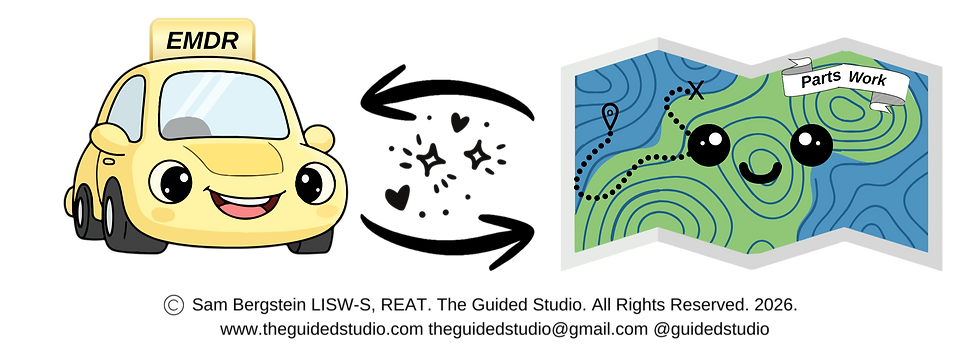
Parts work is the GPS: It shows you the terrain—the mountains (protective parts) and the hidden valleys (wounded parts) that you’ll need to navigate along the way.
This idea of having “parts” isn’t just clinical jargon. It’s a fundamental aspect of being human. And the therapies built on this idea are incredibly effective. Studies on modalities like Internal Family Systems (IFS) and Ego State Therapy have shown they significantly reduce symptoms of depression and PTSD [5][6].
When we blend the two, we stop just treating a memory and start collaborating with the entire person.
3 Ways You Can Start Doing This (Like, in Your Next Session)
You don’t need a whole new certification to start bringing a parts-aware lens to your work. Here are three simple things you can try right away.
1. Plant the “Parts” Seed Early
Don’t wait for a crisis. Introduce the idea of parts casually, right from the beginning.
Sample Script:
“You know, as we do this work, you might notice different, sometimes conflicting, feelings coming up. That’s so normal. I like to think of them as different ‘parts’ of us. Like, maybe there’s a part of you that’s so ready to heal, and another part that’s feeling really nervous about it. Does that make any sense to you?”
2. Listen for the Language
Clients talk in “parts language” all the time! Our job is to just notice it and reflect it back.
When they say: “I don’t know why I keep doing that!
You can say: “I wonder what part of you takes over in those moments?”
When they say: “I know it wasn’t my fault, but I feel so much shame.”
You can say: “It sounds like one part of you knows the truth, but another part is still carrying all that shame.”
3. Draw it Out
When you’re setting up an EMDR target, grab a piece of paper. This doesn’t have to be a masterpiece.
Start with a symbol for the target memory or the block to healing. Then ask, “When you even think about touching on that memory, who shows up? What parts of you have an opinion about this?”
Draw circles for the protectors such as the “Anxious Part,” the “Skeptical Part,” or the “Little Kid Part.” Just seeing it on paper can be a game-changer for both you and your client.

My Go-To Move for Stuck Sessions: The Protector Exploratory Check-In
Okay, if you take only one thing from this article, let it be this. This is my go-to intervention when processing genuinely stalls. It's a simple way to apply the principles of parts work that have been proven effective for PTSD [6].
But first—an important note about when to use this.
Your job as an EMDR therapist is to stay out of the way and let the brain do its work. This intervention is NOT a replacement for standard EMDR protocol. Use it only when:
Processing has stalled for at least 3 sets of bilateral stimulation
Note: Unless the client is out of their window of tolerance: if you're not sure if they're stuck for at least 3 sets, do more sets instead of interfering.
Standard EMDR interventions (interweave, adjusting the target, changing BLS) haven't resolved the block
You've already established a relationship with the client's parts—they understand the concept and can identify when parts show up
The client is within their window of tolerance and able to be reflective
If you're in the first or second set and things feel stuck, just keep going with standard EMDR. Try "Go with that." Try an interweave. Adjust the target. Change the speed of the tapping. The brain often just needs a little more time.
But when you've tried all that and the block persists? That's when this intervention shines.
![A chart titled "Protector exploratory check in". The top of the table says "step", "what to do", and "sample script". The rest of the chart includes the following Step 1: Hit Pause and Name It.
Stop the BLS. Take a breath. Say something like, "Okay, looks like we hit a little speed bump. That's totally fine. It usually just means a protective part of you has stepped in to make sure we're not going too fast. Can we just take a second to check in with that part?"
Step 2: Ask It About Its Job.
Invite your client to focus on the block (the numbness, the looping thought, whatever it is) and ask it directly: "What's your job? What are you trying to do for [client's name] right now?"
Step 3: Ask What It's Afraid Of.
This is the key. "What are you worried would happen if you let us process this memory? What's the catastrophe you're working so hard to prevent?"
Step 4: Appreciate and Negotiate.
Validate, validate, validate. "Wow, thank you for working so hard to keep them from feeling overwhelmed. That makes so much sense. You have a really important job. I'm wondering if you'd be willing to just relax a little, maybe step back just six inches, and let us try to process just a tiny piece of this? We can stop whenever you say so."”](https://static.wixstatic.com/media/b83e77_93de1c3a8f4d46038ac6e3e88534e8d9~mv2.png/v1/fill/w_980,h_757,al_c,q_90,usm_0.66_1.00_0.01,enc_avif,quality_auto/b83e77_93de1c3a8f4d46038ac6e3e88534e8d9~mv2.png)
You Don’t Have to Do It Alone
Bringing a parts-aware lens to your EMDR practice is a journey. It’s about adding more creativity, confidence, and collaboration to the work you already do so well. If this way of working resonates with you, and you’re feeling that little spark of excitement, I want to support you.
Two PDFs to help you
Quick-Start Guide: Parts 101 & Bridging EMDR & Parts Work Check out the free 16 page guide and toolkit that builds off of this blog's material:
Ready to go further? Check out The Complete EMDR & Parts Work Toolkit
I’ve poured everything I’ve learned about this integration into The Complete EMDR & Parts Work Toolkit. It’s a whole library of deep-dive guides, printable worksheets, and beautiful infographics designed to help you bridge these two worlds with confidence.
If you’re ready to move past the stuck points and facilitate even deeper healing for your clients, I invite you to check it out.
Want support with cases and these concepts in real time? Join me in group or individual EMDR consultation!


Comments